

When Does a Company Need a vCISO?
For many companies, the need for a vCISO does not start with a job description. It starts with a customer security questionnaire, an audit requirement, a cyber insurance renewal, a board-level concern, a private equity acquisition, or a security incident that reveals a bigger issue: no one clearly owns cybersecurity at the leadership level.
A virtual Chief Information Security Officer, or vCISO, gives organizations access to experienced cybersecurity leadership without the cost or complexity of hiring a full-time executive. For startups, mid-market companies, private equity portfolio companies, and growing businesses, a vCISO can help turn cybersecurity from a set of disconnected tasks into a governed, measurable, and business-aligned program.
At Socium Security, vCISO support is part of a broader cybersecurity advisory approach focused on strategy, governance, risk management, compliance readiness, and operational execution.
What Is a vCISO?
A vCISO is an outsourced or fractional cybersecurity leader who helps guide an organization’s security program. Unlike a managed service provider or a technical tool vendor, a vCISO focuses on executive-level security leadership.
That includes cybersecurity strategy, risk prioritization, policy governance, compliance planning, board reporting, incident readiness, third-party risk management, and security roadmap development.
A strong vCISO helps answer important business questions, such as:
What are our most significant cybersecurity risks?
Are we ready for SOC 2, ISO 27001, HIPAA, HITRUST, CMMC, or enterprise customer reviews?
Which security initiatives should we prioritize first?
What should executives or the board see each month or quarter?
Are our controls designed considering a risk tolerance, and working as designed?
The value of a vCISO is not just advice. It is ownership, structure, prioritization, and accountability.
When Does a Company Need a vCISO?
A company typically needs a vCISO when cybersecurity becomes important to revenue, compliance, operations, customer trust, or investor confidence, but the organization is not yet ready for a full-time CISO.
Here are the most common signs.
1. Enterprise Customers Are Asking Harder Security Questions
One of the clearest signs a company needs vCISO services is when enterprise customers begin asking detailed security questions. This is common for software companies, SaaS providers, technology firms, content developers, healthcare vendors, and service providers supporting larger organizations.
Many mid-market companies are expected to meet the cybersecurity requirements of Fortune 500 customers, even if they do not have Fortune 500 resources. They may be asked about access controls, encryption, vulnerability management, incident response, vendor risk, business continuity, secure development, and compliance frameworks.
Socium’s work with mid-market companies is designed for this exact challenge: helping growing organizations meet increasing customer, regulatory, and third-party security expectations without creating unnecessary complexity.
A vCISO helps the company create a consistent security story, prepare evidence, respond to customer questionnaires, and build a roadmap that supports revenue growth.
2. The Company Needs SOC 2, ISO 27001, HITRUST, HIPAA, or CMMC Readiness
Compliance is often the trigger that exposes cybersecurity program gaps. A company may need SOC 2 to close enterprise deals, ISO 27001 to support international customers, HIPAA or HITRUST for healthcare requirements, or CMMC for defense-related work. Cybersecurity is now formalized in niche industries like entertainment content with certifications like TPN, or the Trusted Partner Network.
A vCISO helps translate these requirements into practical action. That means identifying applicable controls, assigning owners, preparing documentation, building evidence, managing remediation, and helping leadership understand what is required to pass an audit or assessment.
Socium’s Cybersecurity Assessments & Compliance Readiness services help organizations evaluate current maturity, identify gaps, and prioritize improvements against business and regulatory needs.
3. No One Owns Cybersecurity at the Executive Level
In many growing companies, cybersecurity is informally assigned to IT, engineering, legal, or compliance. These teams may be capable, but they often do not have the authority or bandwidth to make enterprise risk decisions, brief leadership, manage cross-functional priorities, or build a long-term security strategy.
That is where a vCISO becomes valuable. The vCISO creates clear ownership and helps define what “good” looks like based on the company’s size, industry, customers, risk profile, and maturity.
Socium’s Operating Model emphasizes the importance of connecting ownership, execution, and validation. Cybersecurity programs often stall when responsibilities are unclear or when activity is not tied to measurable risk reduction.
4. The Board or Executive Team Needs Better Cybersecurity Reporting
A company needs a vCISO when leadership starts asking cybersecurity questions that cannot be answered with tool dashboards and reporting alone.
Executives and boards want to know whether cyber risk is increasing or decreasing. They want to understand the company’s top risks, open issues, incident readiness, compliance posture, third-party exposure, and whether current investments are reducing meaningful business risk.
This is especially important for private equity-backed companies. After an acquisition, cybersecurity becomes part of value protection, operational resilience, and risk management. Socium’s Private Equity services help firms and portfolio companies assess risk, prioritize remediation, and establish repeatable governance across the investment lifecycle.
A vCISO can create board-ready reporting that translates technical findings into business impact, investment priorities, and clear accountability.
5. Security Work Is Happening, but It Is Not Coordinated
Many companies have security tools in place: endpoint protection, MFA, vulnerability scanning, backups, policies, awareness training, and cloud controls. But tools do not equal a cybersecurity program. Routines create a program, by providing data from processes, and monthly, quarterly, and annual review of the performance of the program.
A vCISO helps organize activity into a structured roadmap. This includes setting priorities, assigning owners, tracking remediation, measuring progress, and ensuring controls are actually operating.
For organizations that need ongoing support, Socium’s Managed Cybersecurity Services can help with program management, vulnerability management, continuous compliance, monitoring, and operational support.
6. The Company Is Growing Faster Than Its Security Program
Growth creates security pressure. New employees, cloud services, vendors, applications, products, customer data, and integrations can quickly outpace informal controls.
A vCISO helps leadership decide where to mature first. Depending on the business, priorities may include identity and access management, secure software development, cloud security, third-party risk, vulnerability management, incident response, or data protection.
For companies developing software or managing sensitive customer environments, Socium’s Penetration Testing & Threat Simulations can validate whether controls hold up against real-world attack scenarios.
7. The Company Is Not Ready for an Incident
Many organizations discover during a crisis that their incident response plan is outdated, untested, or unclear. A vCISO helps prepare the business before an event occurs.
That includes incident response planning, ransomware readiness, executive tabletop exercises, escalation paths, communications planning, backup validation, and post-incident improvement.
Socium’s Business Resilience & Crisis Management services help organizations prepare for disruption and strengthen response capabilities before they are needed.
Understanding vCISO vs. Full-Time CISO
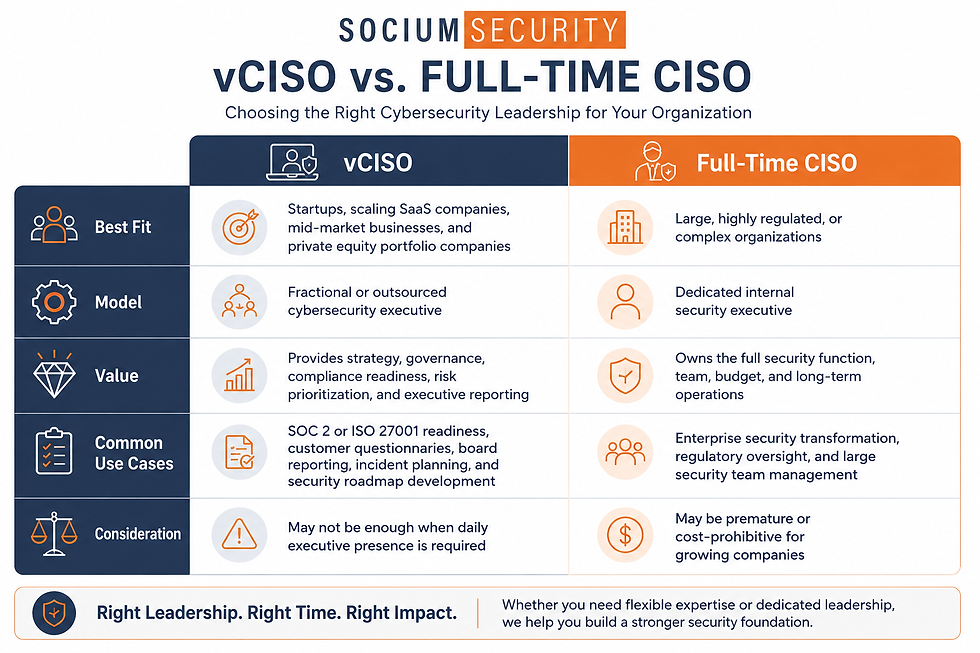
What Should a vCISO Deliver?
A strong vCISO engagement should produce practical outcomes, not just recommendations. In the first 90 days, a company should expect a current-state assessment, prioritized risk register, security roadmap, compliance readiness plan, executive reporting cadence, control ownership model, and near-term remediation priorities.
The goal is to make cybersecurity easier to explain, easier to manage, and easier to validate.
Final Answer: A Company Needs a vCISO When Cybersecurity Requires Leadership
A company needs a vCISO when cybersecurity becomes too important to manage informally. That point often arrives when customers, auditors, regulators, investors, or executives need confidence that cyber risk is being governed and reduced.
The right vCISO helps the organization move from reactive security to a structured, measurable, and defensible cybersecurity program.
To determine whether vCISO support is the right next step, connect with Socium Security through Get Started.


